
Quick Answer
Choose the cabinet finish first, then the countertop against it – the cabinets are the larger surface and the harder thing to change. Quartz suits most Charlotte kitchens: consistent, non-porous, and no resealing. Match undertones rather than colours, view every slab in your own kitchen light, and let one surface be the quiet one. Expect $60-$100 per square foot installed for quartz, $50-$120 for granite, and $100-$200+ for marble.
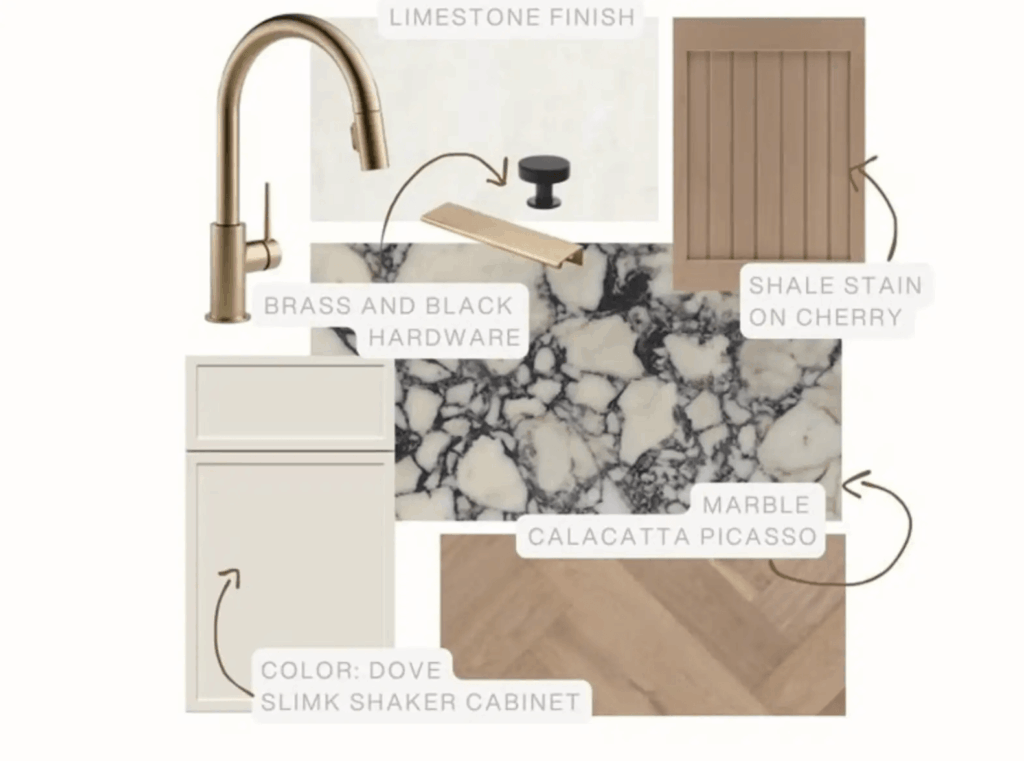
Countertops and cabinets are chosen at the same moment, from two different suppliers, under two different sets of lighting – which is exactly why they so often end up not quite working together.
The pairing is not complicated, but it does have an order and a few rules. Here they are.
Choose the Cabinets First
Cabinetry is the larger visual surface, the larger share of the budget, and by far the harder thing to change later. A countertop can be replaced in a day; cabinetry is a project.
So lock the cabinet finish, then bring door samples to the stone yard. Doing it the other way round means designing the expensive, permanent element around the cheaper, replaceable one.
The One-Surface-Leads Rule
The most reliable principle in the whole subject: one surface should be quiet.
– Dramatic, heavily veined slab? Keep cabinetry calm – a solid painted finish, simple door profile.
– Strongly coloured cabinets, or a bold wood grain? Keep the worktop restrained – a subtle or near-solid surface.
– Want both quiet? Entirely valid, and the result is a calm kitchen where hardware and lighting do the work.
What does not work is two statement surfaces. A dramatic Calacatta beside a heavily figured walnut is two things asking for attention in a room that only has room for one.
Undertones Beat Colours
This is where most mismatches happen, and why they are hard to spot in advance.
Every white has an undertone – warm and creamy, or cool and blue-grey. Same for greys, and for wood finishes. Two surfaces with clashing undertones look wrong even when their colours are objectively similar, and most people cannot articulate why.
The failure we see most often: a warm white oak island beside a cool grey-blue quartz. Both are attractive. Together the oak looks orange and the quartz looks cold.
The test: hold the actual cabinet door against the actual slab, in your own kitchen, at two times of day. Charlotte’s warm late-afternoon light pushes creams and greiges noticeably warmer than showroom lighting does. A pairing that works at 10am and fights at 5pm is the wrong pairing.
The Materials, Honestly
Quartz – engineered stone. Non-porous, so no sealing, and it resists wine, coffee and oil. The slab matches the sample because it is manufactured, which removes the biggest risk in choosing stone from a photograph. It can scorch under a hot pan and strong direct sun can fade some colours over years. $60-$100 per square foot installed. The right answer for most Charlotte kitchens.
Granite – natural stone. Every slab is unique, which is either the appeal or the risk depending on temperament – always view your actual slab, not a sample tile. Very heat tolerant. Porous, so it needs resealing periodically. $50-$120 per square foot installed.
Marble – the look everyone photographs. Porous and acid-reactive, so lemon, wine and vinegar etch it regardless of sealing. Genuinely beautiful and genuinely demanding. $100-$200+ per square foot installed. Best on a baking island or a butler’s pantry rather than a family kitchen’s main run.
Butcher block / wood – warm, and pairs beautifully as a secondary surface on an island. Needs oiling and does not belong around a sink. $40-$70 per square foot installed.
Marble-look quartz deserves its own line, because it is what most people actually want: the veining of marble with none of the etching. It is the most common specification in Charlotte kitchens in 2026.
Pairings That Work in 2026
– Warm white or cream cabinets + white quartz with soft beige veining. The current default. Bright, warm, unlikely to date.
– White oak or natural wood + cream quartz with taupe veining. Warm on warm. Let the wood grain lead and keep the stone quiet.
– Sage, greige or mushroom cabinets + warm white quartz. The stone brightens a muted cabinet colour without introducing a third tone.
– Deep navy or forest island + white marble-look quartz. High contrast, classic, and reads as deliberate rather than trendy.
– Charcoal or iron black cabinets + light quartz with visible movement. The contrast needs the movement, or it looks flat.
– Two-tone kitchen + one countertop throughout. With two cabinet finishes already in play, a single worktop across both is what holds the scheme together.
The through-line: warm neutrals, one leading surface, and no third competing tone.
Practical Details People Forget
Slab backsplash. Running the same stone up the wall behind the range is the single most effective upgrade available at selection stage, and it removes a grout line from the messiest part of the kitchen. Costs more; looks considerably better.
Edge profile. Eased or square for contemporary and transitional; bevelled or ogee for traditional. A mitred edge makes a worktop look thicker than it is and suits modern islands.
Honed vs polished. Honed is matt and contemporary and hides fingerprints; it also absorbs stains more readily, which matters on anything porous. Polished is easier to live with on marble.
Overhang. Allow 15 inches of overhang for comfortable seating at an island, and check whether the span needs support brackets – a detail best resolved before the cabinets are built.
Templating comes after cabinets. Fabricators measure off installed cabinet boxes, not drawings, so the stone cannot be cut until cabinetry is in. Expect 1-2 weeks between template and installation and plan to be without a sink for that window.
Bring the Door to the Slab
The one piece of advice worth more than the rest: never choose a countertop from a screen or a small sample chip. View the full slab, with your actual cabinet door in your hand, in daylight.
We give clients their door samples to take to the stone yard for exactly this reason, and we render the pairing in 3D so you can see the two surfaces together at full scale before either is ordered.
If you are choosing both at once, bring it to a free design consultation and we will work through the combination properly. We serve Charlotte, Ballantyne, SouthPark, Myers Park, Matthews, Huntersville, Lake Norman, Concord, Waxhaw, Fort Mill, Rock Hill, and surrounding NC/SC communities.
Frequently Asked Questions
What countertop goes best with white cabinets?
White cabinets are the most flexible base, so the choice depends on the effect you want. A white or lightly veined quartz gives a clean, seamless look. A warm-veined marble or marble-look quartz adds movement and warmth without colour. A darker granite or soapstone-look quartz creates contrast and grounds the room. The main thing to check is undertone – a cool white cabinet beside a cream-veined slab can look slightly dirty rather than deliberate.
What countertop works with natural wood or white oak cabinets?
Warm-toned surfaces. A white or cream quartz with soft beige or taupe veining complements white oak without competing with the grain. Avoid cool grey-blue quartz, which fights the wood’s warmth and is the most common mismatch we see. Because wood grain already provides visual movement, a quieter slab usually produces the better result.
Is quartz or granite better for a kitchen?
For most Charlotte kitchens, quartz. It is non-porous so it never needs sealing, it resists staining from wine, coffee and oil, and because it is engineered the slab matches the sample you chose. Granite is natural stone, so every slab is unique and some homeowners prefer that character, but it is porous and needs periodic resealing. Granite tolerates heat better; quartz can scorch, so trivets are needed either way.
How much do countertops cost in Charlotte?
In 2026, expect roughly $60-$100 per square foot installed for quartz, $50-$120 for granite, $100-$200+ for marble, and $40-$70 for butcher block. A typical kitchen uses 40-55 square feet. Edge profile, cut-outs for sinks and cooktops, and whether you add a full-height slab backsplash all move the final figure.
Should countertops be lighter or darker than cabinets?
Either works; what matters is that there is enough contrast to read as intentional. A light worktop on darker cabinetry keeps the room feeling open and is the safer choice in smaller kitchens. A darker worktop on light cabinetry grounds the space and hides everyday marks better. What rarely works is a countertop only slightly different from the cabinet colour – it reads as a failed match rather than a choice.
Is marble a bad idea in a family kitchen?
Marble is porous and reacts with acids, so lemon juice, wine and vinegar can etch the surface even when it is sealed. Some owners accept that patina as character; others find it a daily irritation. If you love the look but not the maintenance, a marble-look quartz gives you the veining with none of the etching, and it is what most Charlotte families choose.
Ready to start your cabinet project?
Visit Our Showrooms
We’d love to welcome you to one of our showroom locations. Visit us to explore our cabinetry collections, discuss your project, and experience the craftsmanship that defines FigTree Cabinets.