
Quick Answer
Two-tone works when the split follows the architecture rather than taste alone. The reliable formula is a lighter perimeter with a darker or wood island, or wood uppers over painted bases. Keep it to two finishes, let one clearly dominate at roughly 70/30, and tie them together with a single hardware finish. Expect a modest premium — usually a few hundred dollars — because it is a second finish run, not a second kitchen.
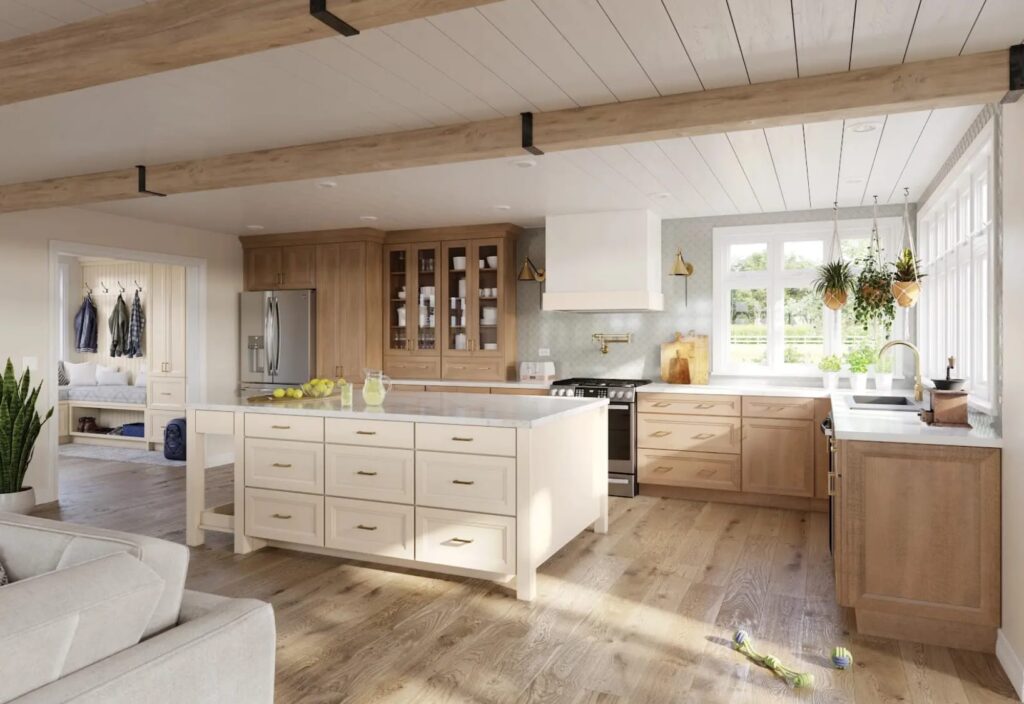
Two-tone kitchens are one of the few design choices that can make a kitchen look considerably more expensive without costing considerably more. They are also one of the easiest to get wrong, because the difference between a two-tone kitchen that looks designed and one that looks like the island was ordered separately is a set of decisions most people make by instinct.
Here is how to make those decisions deliberately.
Why Two-Tone Works
A single-finish kitchen is calm but flat. Two finishes give a room hierarchy — something to look at first, something to look at second — and that hierarchy is what the eye reads as “designed.”
Practically, two-tone also solves real problems. It lets a large open-plan kitchen relate to the living space around it instead of dominating it. It gives a small kitchen a light perimeter without the whole room feeling washed out. And it lets you use a beautiful, expensive wood on the island without paying for it across thirty linear feet.
The 70/30 Rule
Fifty-fifty splits are where two-tone kitchens go wrong. When neither finish leads, the eye cannot settle, and the room reads as indecisive rather than layered. Pick the dominant finish first — almost always the perimeter — and choose the accent to sit alongside it.
Where to Put the Split
The island. The most common and the most forgiving. The island is a distinct object in the room, so a different finish on it reads as intentional immediately. This is the right starting point if you are unsure.
Uppers versus bases. Wood or light uppers over darker painted bases. This grounds the room and is particularly effective with ceilings of nine feet or more. It also hides wear where it actually happens, since base cabinets take the scuffs.
Tall run versus the rest. A floor-to-ceiling pantry and refrigerator wall in one finish, with the working run in another. Good in open-plan kitchens where the tall wall reads as furniture from the living area.
The hood or a feature wall. The most restrained version — a wood or contrasting hood surround against an otherwise single-finish kitchen. A small amount of contrast in exactly the right place.
What does not work is a colour change that stops in the middle of a cabinet run with no break in the architecture. The eye reads it as an error, because there is nothing to explain it.
The Combinations That Work in 2026
– Greige or mushroom perimeter + walnut island. Richer and more enveloping. Excellent in kitchens with good natural light.
– Sage perimeter + natural oak island. Soft, current, and distinctly not-white without being bold.
– Off-white perimeter + deep navy island. The classic. Still works, and reads as timeless rather than trendy.
– Wood uppers + painted bases in charcoal or forest. Confident and less common. Very effective with tall ceilings.
Undertones Matter More Than Colour
Warm white oak beside a cool grey-blue looks slightly off, and most people cannot articulate why. A warm greige beside the same oak looks resolved. The colours are equally different in both cases; the undertones are not.
Practical test: put the actual wood sample and the actual painted door together, in your kitchen, at two different times of day. Charlotte’s afternoon light is warm and will push greige and mushroom noticeably warmer than they looked under showroom lighting. A combination that works at 10am and fights at 5pm is not the right combination.
What Ties It Together
One hardware finish. Use the same metal on both. Brass, matte black, or brushed nickel throughout. Mixing cabinet finishes and metal finishes at the same time is the fastest route to a kitchen that looks accidental.
A repeat of the accent. The secondary finish should appear at least once more in the room — open shelving, the hood, a window seat, a butler’s pantry, or the back of a peninsula. One isolated island in a different colour is an outlier; the same colour appearing twice is a scheme.
A shared door style. Keep the same door profile across both finishes. Two colours and two door styles is one variable too many.
Common Mistakes
– Too much contrast in a small kitchen. Under about 150 square feet, high contrast chops the room into pieces. Keep the two tones close in value.
– Matching the island to the floor. A wood island against a similar wood floor blurs together and loses the effect entirely. Separate them by at least two shades, or paint the island.
– Choosing from a screen. Finishes photograph inaccurately, and undertone is exactly what a screen fails to reproduce.
What It Costs
Costs rise if one finish is a custom colour match, a specialty stain, or a wood species outside the standard offering. But a painted perimeter with a natural oak island, using standard finishes, is one of the cheapest ways to make a kitchen look genuinely designed.
For reference, cabinetry itself runs $300–$650 per linear foot installed for semi-custom in Charlotte in 2026, and $650–$1,200+ for full custom. The two-tone decision moves that number far less than the tier decision does.
Start With the Island
That formula is difficult to get wrong, works in almost every Charlotte home, and is the starting point for most of the two-tone kitchens we build.
Bring photos of kitchens you like to a free design consultation and we will render your actual kitchen in two or three combinations so you can see them in your own space, at your own ceiling height, before anything is ordered. We serve Charlotte, Ballantyne, SouthPark, Myers Park, Matthews, Huntersville, Lake Norman, Concord, Waxhaw, Fort Mill, Rock Hill, and surrounding NC/SC communities.
Frequently Asked Questions
Are two-tone kitchen cabinets still in style in 2026?
What is the most popular two-tone cabinet combination?
Should the island be lighter or darker than the perimeter?
Do two-tone cabinets cost more?
Do two-tone cabinets hurt resale value?
Can you mix wood and painted cabinets in the same kitchen?
Yes, and it is currently the most popular form of two-tone. The key is matching undertones: a warm white oak sits comfortably beside warm whites, greige, mushroom, and sage, but fights cool grey-blues. Bring the actual wood sample and the paint sample together in your own kitchen light before committing — undertone clashes are difficult to see in a showroom.
Ready to start your cabinet project?
Visit Our Showrooms
We’d love to welcome you to one of our showroom locations. Visit us to explore our cabinetry collections, discuss your project, and experience the craftsmanship that defines FigTree Cabinets.