
Kitchen Cabinet Hardware Guide for Charlotte Homes: Pulls, Knobs, Hinges & 2026 Trends
Quick Answer
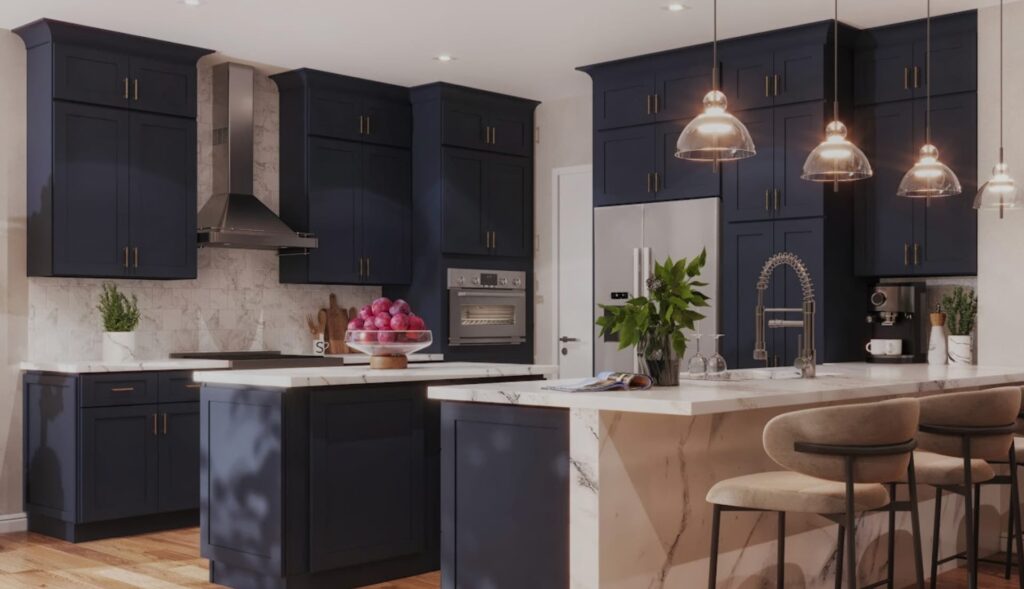
This guide covers both halves of hardware: the visible pieces you choose for style (knobs and pulls) and the hidden pieces that make cabinets a joy to use (hinges and slides). Here’s how we spec hardware on Charlotte kitchens.
Knobs vs Pulls: Pick a System
There are three common systems, and any of them looks great as long as you’re consistent:
– Pulls on everything. Doors and drawers all get pulls. Reads modern and streamlined, and it’s the fastest to operate with full hands.
– Knobs on everything. Less common now; works on traditional inset cabinetry but is harder to grip on heavy drawers.
The mistake isn’t choosing the ‘wrong’ system — it’s mixing systems randomly across the kitchen. Pick one rule and hold to it.
Sizing: The One-Third Rule
– 9–12 inch drawer → 3–4 inch pull
– 15–18 inch drawer → 5–6 inch pull
– 24 inch drawer → 6–8 inch pull
– 30–36 inch drawer → 8–12 inch pull, or two pulls, or a single appliance-style pull
For doors, a 3–4 inch pull or a 1.25–1.5 inch knob suits most standard cabinets. Tall pantry and appliance-panel doors look best with longer pulls (12 inches and up) to match their scale.
Placement: Consistency Beats Precision
Drawers: Center pulls horizontally. On standard-height drawers, center them vertically too. On tall drawer fronts (10 inches and up), mounting the pull slightly above center usually looks and feels better.
Whatever measurements you choose, apply them identically across every cabinet. The eye reads consistency as quality.
2026 Finishes: What's Leading in Charlotte
Matte black remains strong, especially in modern and modern-farmhouse kitchens. It’s crisp, graphic, and hides fingerprints well.
Brushed/satin nickel is the safe, widely-liked middle — warm-neutral, forgiving, and always in style.
Polished chrome is on the decline as kitchens move warmer, though it still fits sleek contemporary and some classic looks.
Aged/oil-rubbed bronze has cooled off but still suits traditional and craftsman homes.
Mixing Metals (The Right Way)
1. Limit to two metals in the room (for example, unlacquered brass hardware + matte black faucet).
2. Repeat each metal at least twice so it reads as a palette, not a one-off. Brass on the hardware and the pendant lights; black on the faucet and the window frames.
A very common, well-loved 2026 Charlotte combination is warm brass cabinet hardware with a matte black or brushed nickel faucet.
The Hardware You Don't See: Hinges and Slides
Soft-close concealed hinges catch the door in its last few inches and close it silently. No slamming, no pinched fingers, no cabinet-door bang echoing through the house at 6 a.m.
Full-extension, soft-close drawer slides let the drawer pull all the way out (so you can reach the very back) and glide shut quietly under load. Undermount slides hide the mechanism for a clean look inside the drawer.
Both are standard on every Fig Tree cabinet. If you’re comparing quotes elsewhere, confirm these are included — cheaper cabinets sometimes use partial-extension or non-soft-close slides to hit a price, and you feel the difference every single day.
What Hardware Costs
– Good-quality knobs and pulls: $8–$25 per piece
– Designer or solid-brass hardware: $30–$60+ per piece
– A typical Charlotte kitchen (30–50 pieces): roughly $400–$1,200 for mainstream hardware, or $1,500–$3,000 for designer pieces
Because the count is fixed, hardware is an easy place to either save (clean, simple pulls that look great) or splurge (statement solid-brass pieces) depending on your budget.
Common Hardware Mistakes in Charlotte Kitchens
2. Inconsistent placement. Pulls at different heights across drawers reads as sloppy even if no one can say why.
3. Too many metals. Three-plus finishes in one kitchen usually looks unplanned. Cap it at two.
4. Cheap slides and hinges to save money. You feel this every day; it’s the wrong place to economize.
5. Choosing hardware last, in isolation. Bring hardware, faucet, and lighting finishes together early so the metals coordinate.
Let's Get the Details Right
Hardware is where a kitchen goes from ‘nice cabinets’ to ‘finished room.’ In our Charlotte showroom you can hold the actual pulls, feel the weight of solid brass versus plated, and test soft-close hinges and slides before you decide. A free consultation includes hardware and finish coordination as part of the design — so the jewelry of your kitchen fits the rest of the room. We serve Charlotte, Ballantyne, SouthPark, Matthews, Huntersville, Lake Norman, Concord, Fort Mill, Rock Hill, and surrounding NC/SC communities.
Frequently Asked Questions
Should I use knobs or pulls on kitchen cabinets?
What size pulls should I use on cabinet drawers?
What cabinet hardware finish is trending in 2026?
Do cabinet hardware finishes have to match the faucet?
How much does cabinet hardware cost for a whole kitchen?
What are soft-close hinges and are they worth it?
Where should you place knobs and pulls on cabinets?
Ready to start your cabinet project?
Visit Our Showrooms
We’d love to welcome you to one of our showroom locations. Visit us to explore our cabinetry collections, discuss your project, and experience the craftsmanship that defines FigTree Cabinets.