
Quick Answer
Painted cabinets give a clean, bright, updated look and are the resale-safe choice in Charlotte, but they cost 10–20% more and show chips and touch-ups more visibly. Stained cabinets show off real wood grain, hide wear and touch-ups better, and cost less, but read warmer and more traditional. For most Charlotte kitchens we recommend painted perimeters with a stained wood island — you get brightness and warmth in one kitchen.
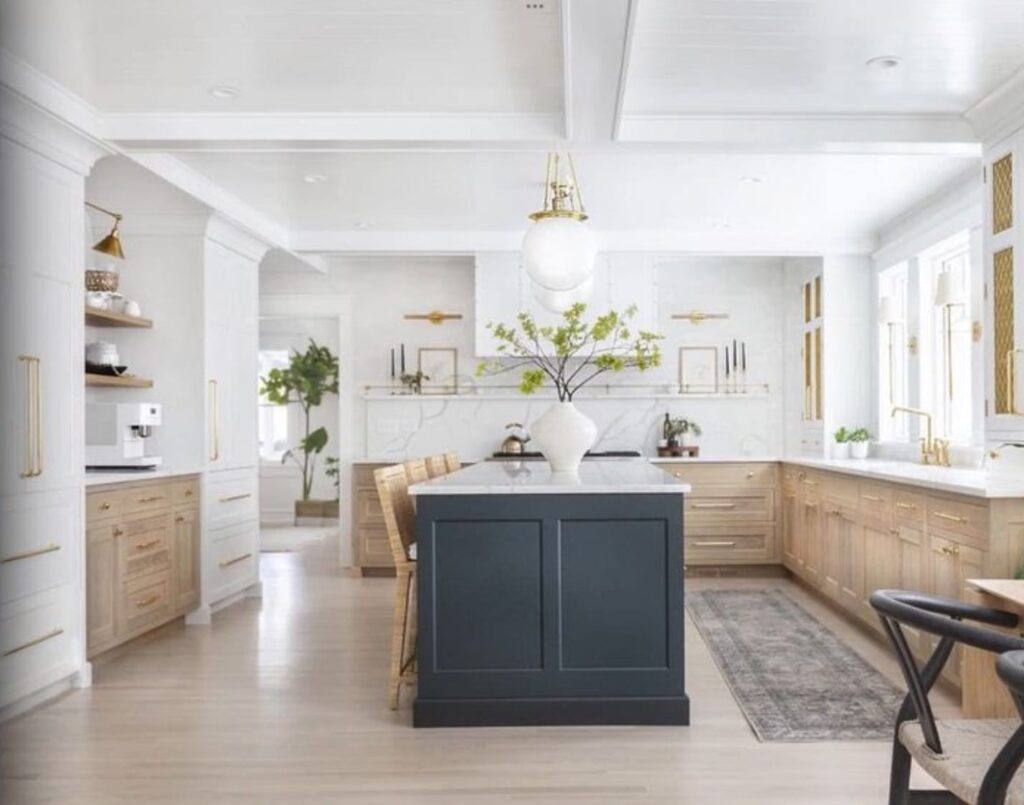
Painted or stained? It’s one of the first questions we ask in a Charlotte kitchen consultation, and it drives more of the final look than almost any other decision. Both can be beautiful, both can last decades — but they age differently, cost differently, and send very different signals about the style of your home.
Here’s the honest designer’s comparison, from a company that finishes both every week. No agenda — just what each finish does well, where each falls short, and how to choose for your specific kitchen.
Here’s the honest designer’s comparison, from a company that finishes both every week. No agenda — just what each finish does well, where each falls short, and how to choose for your specific kitchen.
The Core Difference
Stain is a penetrating finish. It soaks into the wood and lets the grain show through, then gets a clear protective topcoat. You’re seeing and feeling real wood.
Paint is an opaque finish. It sits on top of the wood as a solid color, hiding the grain entirely, then gets its own protective topcoat. You’re seeing color and a smooth surface, not wood.
That single difference — grain showing vs grain hidden — drives everything else: the look, the cost, how wear shows, and how touch-ups blend.
Look and Style
Painted reads clean, bright, and current. White and warm-white painted kitchens are the default ‘updated kitchen’ look, and painted color (sage, greige, navy) is where a lot of 2026 Charlotte kitchens are heading. Paint suits transitional, modern, and modern-farmhouse homes especially well.
Stained reads warm, natural, and grounded. It shows off the character of the wood — the grain, the movement, the depth. Stained white oak and walnut look distinctly modern; stained cherry and hickory read traditional. Stain suits craftsman, rustic, traditional, and warm-modern interiors.
Neither is more ‘high-end’ than the other. A stained rift-sawn white-oak kitchen and a hand-painted inset kitchen can both be top-tier — they just speak different design languages.
Durability and Everyday Wear
This is where stained cabinets have a practical edge. Because stain is in the wood and the grain breaks up your eye’s read of the surface, stained cabinets hide fingerprints, scuffs, and small dings better. When wear does happen, touch-ups blend in more easily.
Painted cabinets are just as durable structurally — a quality conversion-varnish or 2K finish is tough — but because the color is a solid uniform layer, any chip at a high-contact edge is more visible. A dinged corner on a white cabinet shows the substrate underneath; the same ding on a stained cabinet often disappears into the grain.
For a hard-working family kitchen with kids and pets, this visibility difference is worth weighing honestly. It doesn’t rule out paint — it just means you should keep touch-up paint on hand.
Touch-Ups and Repairs
Stained: Easier to blend. A stain marker or a little matching stain and topcoat usually makes a scratch vanish. Wood is also sandable and refinishable years down the road.
Painted: Touch-ups are doable but less forgiving — paint can flash (show a slightly different sheen) where you touch up, especially on older finishes. Keeping a small labeled container of your exact paint makes this far easier. Over many years, painted cabinets can be repainted, which is a bigger job than a spot stain repair but fully renews the kitchen.
Painted: Touch-ups are doable but less forgiving — paint can flash (show a slightly different sheen) where you touch up, especially on older finishes. Keeping a small labeled container of your exact paint makes this far easier. Over many years, painted cabinets can be repainted, which is a bigger job than a spot stain repair but fully renews the kitchen.
Cost
Painted cabinets typically run 10–20% more than the same door in a stained finish. Painting is more labor-intensive — priming, sanding between coats, multiple color coats, and a topcoat — and painted doors usually use an MDF center panel (for a crack-free surface), which adds a step. Stained finishes have fewer steps and use the natural wood, so they cost less for an equivalent door style.
If budget is tight and you love the look of wood, stain lets you put more of your money into boxes, drawers, and hardware.
If budget is tight and you love the look of wood, stain lets you put more of your money into boxes, drawers, and hardware.
Resale Value in Charlotte
In the Charlotte market, painted neutrals have the broadest resale appeal — white, warm white, greige, soft sage, and navy all read as current and please the widest range of buyers in Ballantyne, SouthPark, Waxhaw, and Lake Norman.
Stained cabinets can absolutely help resale when they’re modern (rift-sawn white oak, walnut) — but dated stains hurt it. Golden oak and orange-toned cherry are the finishes most likely to read ‘needs updating’ to a 2026 buyer. If you’re staining for resale, stay in the modern white-oak/walnut lane.
Stained cabinets can absolutely help resale when they’re modern (rift-sawn white oak, walnut) — but dated stains hurt it. Golden oak and orange-toned cherry are the finishes most likely to read ‘needs updating’ to a 2026 buyer. If you’re staining for resale, stay in the modern white-oak/walnut lane.
The Charlotte 2026 Answer: Do Both
The most-requested look in our showroom right now isn’t painted OR stained — it’s both. A painted perimeter (white, sage, greige, or navy) with a stained natural-wood island (white oak or walnut) gives you the brightness of paint on the working walls and the warmth of real wood at the center of the room.
It photographs beautifully, it’s resale-safe, and it solves the ‘I want bright but not cold’ problem that so many Charlotte homeowners describe. If you can’t decide, this is usually the answer.
It photographs beautifully, it’s resale-safe, and it solves the ‘I want bright but not cold’ problem that so many Charlotte homeowners describe. If you can’t decide, this is usually the answer.
How to Choose for Your Kitchen
– Want the brightest, most updated look and plan to sell within 10 years? Painted neutral.
– Busy family kitchen, want wear to hide, love natural wood? Stained white oak or walnut.
– Traditional or craftsman home? Stain leans with the architecture; a painted island can still add a lift.
– Modern or transitional home, want warmth without going all-wood? Painted perimeter + stained island.
– Tight budget but want a rich look? Stain, and invest the savings in drawers and hardware.
A Note on Finish Quality
Whichever you choose, the topcoat matters more than the color in Charlotte’s humidity. Specify conversion varnish or 2K polyurethane — both resist moisture and won’t yellow under cleaners and sunlight. A great finish makes either paint or stain last for decades; a cheap finish undermines both.
See Both in Person
The fastest way to decide is to stand in front of real painted and stained doors in the light of your own finishes. We keep both in our showroom and can bring samples to your Charlotte home so you can see them against your floors, counters, and natural light. A free consultation includes finish recommendations tailored to your style, your kitchen’s light, and how hard your household uses the space. We serve Charlotte, Ballantyne, SouthPark, Matthews, Huntersville, Lake Norman, Concord, Fort Mill, Rock Hill, and surrounding NC/SC communities.
Frequently Asked Questions
Are painted or stained cabinets better?
Neither is universally better — they’re better at different things. Painted cabinets look cleaner, brighter, and more updated, and they’re more resale-safe in Charlotte. Stained cabinets show off natural wood grain, hide daily wear and touch-ups better, and cost less. The best choice depends on your home’s style, how hard your kitchen gets used, and whether you value a bright look or a warm one.
Do painted cabinets chip easily?
Quality painted cabinets with a conversion-varnish or 2K polyurethane finish are durable, but any painted surface will eventually show chips and dings at high-contact edges — and because paint sits on top of the wood, those chips are more visible than on stained cabinets. The good news is painted cabinets are easy to touch up if you keep a small amount of the original paint.
Are painted cabinets more expensive than stained?
Yes, typically 10–20% more. Painting is a more labor-intensive, multi-step process (prime, sand, multiple coats) and usually uses an MDF center panel for a crack-free surface. Stained finishes require fewer steps and show the natural wood, so they generally cost less for the same door style in Charlotte.
Which cabinet finish is best for resale in Charlotte?
Painted cabinets in a timeless color — white, warm white, greige, soft sage, or navy — have the broadest resale appeal across the Charlotte market. Stained cabinets can be a strong resale feature in modern homes (rift-sawn white oak, walnut) but can feel dated if they’re an orange-toned cherry or golden oak. When in doubt for resale, a painted neutral is the safer bet.
Do stained cabinets hide wear better than painted?
Yes. Because stain penetrates the wood and the grain naturally camouflages marks, stained cabinets hide fingerprints, scuffs, and minor dings better than painted cabinets. Touch-ups also blend more easily. This makes stained cabinets a practical choice for busy family kitchens with kids and pets.
Can you have both painted and stained cabinets in one kitchen?
Absolutely — it’s one of the most popular looks in Charlotte for 2026. The most common combination is a painted perimeter (white, sage, or navy) with a stained natural-wood island (white oak or walnut). This gives you the brightness of paint and the warmth of wood in a single kitchen, and it reads as intentional rather than indecisive.
Does humidity affect painted or stained cabinets in Charlotte?
Both hold up well when built and finished correctly for Charlotte’s humidity. The key is the finish, not paint vs stain: specify a conversion-varnish or 2K polyurethane topcoat, which is moisture-resistant and won’t yellow. Painted solid-wood panels can hairline-crack seasonally as the wood moves, which is why quality painted doors use an MDF center panel that stays stable.
Ready to start your cabinet project?
Visit Our Showrooms
We’d love to welcome you to one of our showroom locations. Visit us to explore our cabinetry collections, discuss your project, and experience the craftsmanship that defines FigTree Cabinets.