
Best Kitchen Cabinet Materials: Plywood vs MDF vs Solid Wood (Charlotte NC Guide)
Quick Answer
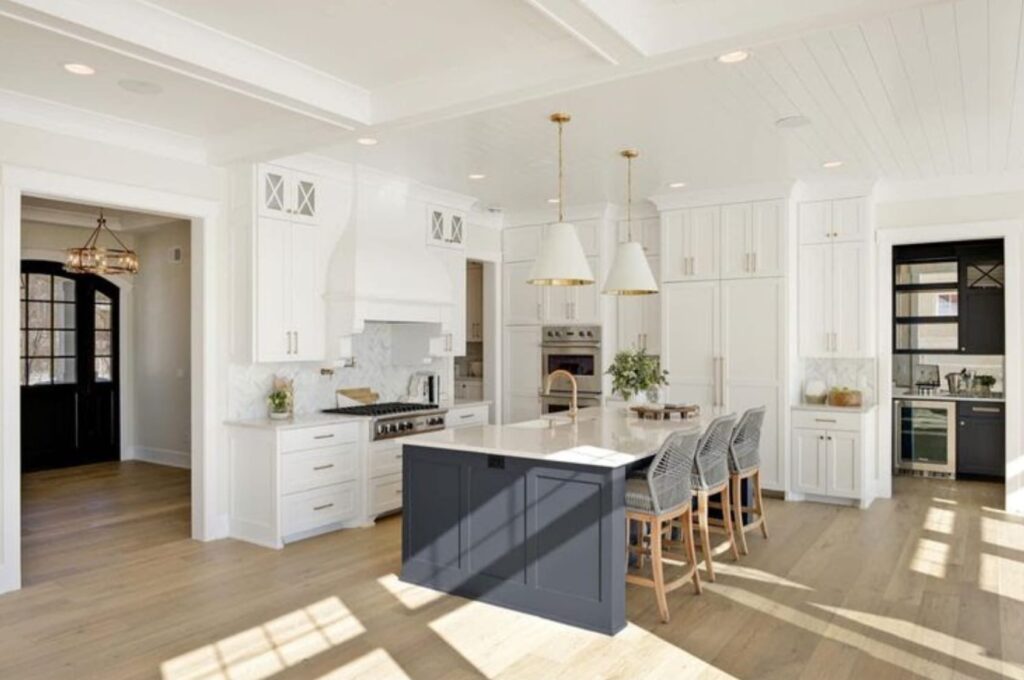
This guide breaks down every material used in kitchen cabinets — plywood, MDF, particleboard, solid wood, and thermofoil — so you can read a quote accurately and specify the right material for each part of your kitchen. We build with these materials every day, and the goal here is to tell you what actually holds up in Charlotte’s climate, not what sounds best on a spec sheet.
First, Separate the Box From the Doors
Every cabinet is two decisions, not one:
– The doors and face frames: the parts you see and touch. This is where finish, style, and grain live.
Plywood: The Best All-Around Box Material
Strengths: Excellent screw-holding (critical for hanging heavy uppers and mounting hinges), high strength-to-weight ratio, strong resistance to moisture, and it carries the weight of quartz and stone countertops without sagging over time.
Weaknesses: More expensive than particleboard, and lower grades can have interior voids. Quality varies — a 9-ply cabinet-grade panel is far better than a cheap 5-ply.
Our take for Charlotte: Plywood is the default box material we recommend, especially for base cabinets, sink bases, and anything near a dishwasher. In a humid climate, the moisture resistance alone justifies the upgrade.
MDF: The Best Material for Painted Doors
MDF (medium-density fiberboard) is wood fibers compressed with resin into a dense, perfectly uniform panel with no grain.
Strengths: Zero grain telegraphing (paint goes on glass-smooth), no seasonal expansion at the joints, and it won’t crack where a solid-wood panel would. This is why high-end painted cabinets frequently use an MDF center panel even inside a solid-wood door frame.
Weaknesses: Heavy, and it swells permanently if water reaches the core — so edges must be sealed and it should stay out of standing-water zones. It also doesn’t hold screws as well as plywood in structural roles.
Our take for Charlotte: MDF is the right call for painted doors and painted center panels. We don’t recommend it for structural boxes in wet areas, but for a smooth, durable painted finish that won’t crack in year three, it beats solid wood.
Particleboard (Furniture Board): The Budget Box
Strengths: Inexpensive, flat, and stable in dry conditions. A laminated particleboard interior wipes clean easily.
Weaknesses: The big one is moisture. Once water reaches the core, particleboard swells, crumbles, and does not recover. It also holds screws poorly, so hinges and drawer slides can loosen over years of use.
Our take for Charlotte: Fine for a rental, a flip, or a laundry room. Not what we’d put under a Charlotte kitchen sink or in a primary bathroom, where a single slow leak or years of humidity can destroy the box. If a quote is dramatically cheaper than the others, particleboard boxes are usually why.
Solid Wood: Beautiful for Frames, Risky for Boxes
Strengths: Unmatched for stained finishes and natural grain, extremely repairable (it can be sanded and refinished), and it reads as premium because it is. Solid-wood face frames and door frames are a hallmark of quality cabinetry.
Weaknesses: It moves. Wood expands and contracts with humidity, so large solid panels can cup, crack, or split at the seams — which is exactly what happens in a swingy climate if a wide solid panel is used where it shouldn’t be. That movement is why solid wood is used for narrow frame pieces, not big flat boxes.
Our take for Charlotte: Solid wood belongs on the parts you see and in narrow structural pieces — face frames, door frames, drawer fronts. For a stained white-oak or walnut kitchen, solid-wood frames with a matching veneered-plywood panel give you the look without the seasonal cracking.
Thermofoil: Convenient, but Watch the Heat
Strengths: Inexpensive, seamless (no joints to collect grime), and available in colors and wood-looks. Great for laundry rooms and low-budget kitchens.
Weaknesses: Heat and moisture are its enemies. It can peel or delaminate next to ovens and dishwashers and in steamy bathrooms — and once it lifts, the whole door must be replaced. It also can’t be repaired or refinished.
Our take for Charlotte: Usable in dry, low-heat spaces. We steer clients away from thermofoil next to ranges, dishwashers, and in primary baths, where Charlotte’s humidity plus appliance heat shortens its life.
The Finish Is a Material Decision Too
What We Actually Build For a Charlotte Kitchen
For a typical mid-to-high-end Charlotte kitchen, the construction we recommend is:
– Box: 3/4-inch cabinet-grade plywood
– Face frames and door frames: solid wood (species to match the finish)
– Painted center panels: MDF, for a crack-free painted surface
– Stained center panels: veneered plywood matched to the frame species
– Finish: conversion varnish or 2K polyurethane
– Drawer boxes: solid-wood dovetail with full-extension soft-close slides
This mix isn’t the cheapest and it isn’t the most expensive — it’s the combination that survives Charlotte humidity, daily family use, and the weight of stone countertops for 20-plus years.
How to Read a Cabinet Quote Like a Pro
Ready to Talk Materials for Your Charlotte Kitchen?
Frequently Asked Questions
What is the best material for kitchen cabinets?
Is plywood or MDF better for cabinets?
Are particleboard cabinets bad?
Do solid wood cabinets warp?
What cabinet material is best for humidity?
Is thermofoil a good cabinet material?
What material are custom cabinets made of?
Most quality custom cabinets in Charlotte are built from a plywood box with solid-wood face frames and doors, or solid-wood frames with MDF panels for painted finishes. Full custom lets you choose the species (white oak, walnut, maple, cherry) and the panel construction to match your finish and budget.
Ready to start your cabinet project?
Visit Our Showrooms
We’d love to welcome you to one of our showroom locations. Visit us to explore our cabinetry collections, discuss your project, and experience the craftsmanship that defines FigTree Cabinets.