
Cabinet Refacing vs Replacing in Charlotte NC: Cost, Pros, and When Each Makes Sense
Quick Answer
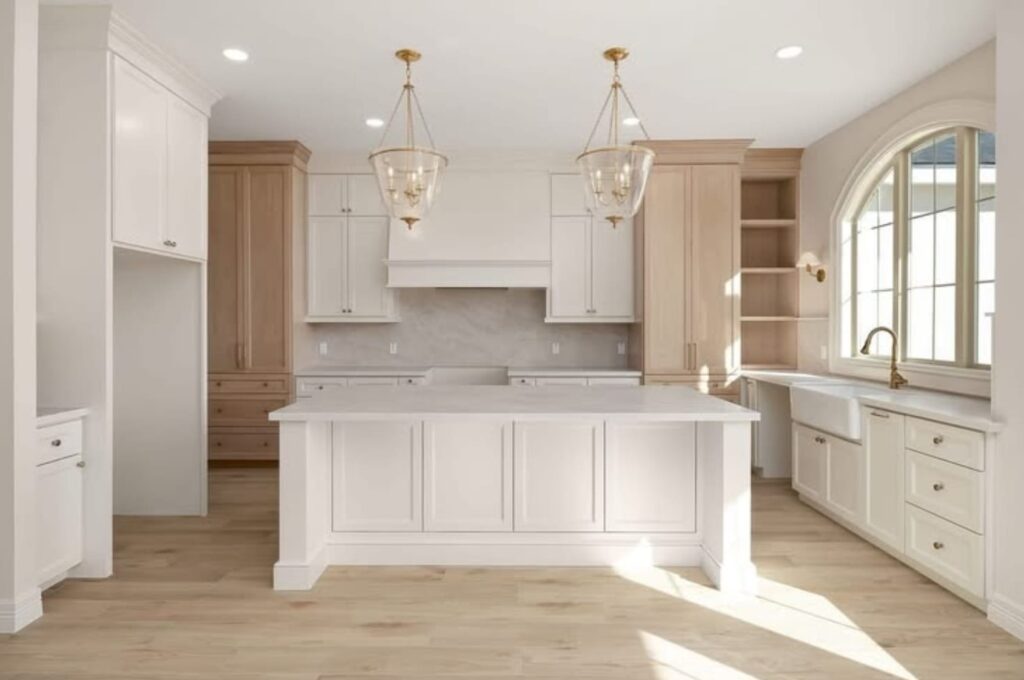
If your Charlotte kitchen feels dated but the cabinets aren’t falling apart, you’ve probably wondered whether you can update the look without the cost and chaos of a full remodel. That’s the refacing-versus-replacing question — and the answer comes down to two things most people overlook: your layout, and what your cabinet boxes are actually made of.
We do both refacing and full replacement, so we have no reason to push you toward one or the other. Here’s the honest breakdown of what each option costs, how long each lasts, and the simple test that decides it for most Charlotte homeowners.
The Three Options, Defined
People use these terms loosely, so let’s be precise:
Refinishing keeps your existing doors and boxes and re-coats them — sanding and repainting or re-staining. It’s the cheapest option and the least disruptive, but you’re stuck with your current door style.
Refacing keeps your cabinet boxes but replaces the doors and drawer fronts entirely, and covers the visible box exteriors with a new veneer or laminate skin that matches. You get a new door style, new color, and new hardware — while the boxes stay put.
Replacement removes everything and installs all-new cabinets. It’s the only option that lets you change the layout, cabinet sizes, and interior function.
The One Test That Decides It: Your Layout
Before cost, before door styles, before anything else, answer one question: does your current kitchen layout actually work for you?
If the answer is yes — the sink is where you want it, the island is the right size, you have enough counter and storage, and you just don’t like how it looks — then refacing is genuinely on the table and can save you a lot of money.
If the answer is no — you want to move the sink, add or resize an island, replace lower doors with deep drawers, add pull-outs, take the uppers to the ceiling, or open a wall — then you need replacement. Refacing locks in your existing layout permanently, so refacing a layout you don’t love just buys you a prettier version of the same frustration.
The Second Test: What Are Your Boxes Made Of?
Refacing only works if the boxes it’s built on are sound. Open a few cabinet doors and look:
– Solid plywood boxes, square and tight, no water damage → good refacing candidate.
– Particleboard boxes that are swollen, crumbling at the sink base, or sagging shelves → replace. There’s no point bonding beautiful new doors to a box that’s failing.
2026 Charlotte Cost Comparison
Real ranges for a standard Charlotte kitchen (roughly 20–30 linear feet of cabinetry):
Pros and Cons at a Glance
Refacing cons: You keep your existing layout and cabinet sizes, you can’t add interior function you don’t already have, and it’s only as good as the boxes underneath.
Replacement pros: Total freedom on layout, sizes, and function; brand-new boxes and interiors; the right move if anything structural is compromised.
Replacement cons: Costs more, 8–12 week total timeline, and significantly more disruption and demolition.
Timeline and Disruption
Refacing is usually a 3–5 day on-site job after the doors are made. Your boxes stay in place, so your kitchen is largely functional throughout, and the mess is minimal.
Replacement is a longer arc: 8–12 weeks from design to finish, including 4–8 weeks of production, then 1–3 days of install — but with full demolition, a period without a working kitchen, countertop removal and re-templating, and more dust and coordination overall.
Which We'd Recommend, By Situation
– Layout works, plywood boxes, you just want a fresh look and a new color? Reface. It’s the value play and you’ll be thrilled with the result for a fraction of the cost.
– Layout is wrong, or boxes are particleboard/water-damaged? Replace. Refacing here is money spent to preserve the exact things you don’t like.
– You love the layout but want deep drawers and pull-outs? This is the gray zone. Sometimes a hybrid — reface the uppers, replace the base cabinets with new drawer banks — is the smart middle path. It’s worth a conversation.
– Selling within a year and the kitchen just looks tired? Reface or refinish for the best cost-to-impact ratio.
– Forever home, and the kitchen has never quite worked? Replace and get it right once.
The Hybrid Option Most People Don't Know About
Get an Honest Assessment for Your Charlotte Kitchen
Frequently Asked Questions
Is it cheaper to reface or replace cabinets?
What is the difference between refacing and refinishing cabinets?
How long do refaced cabinets last?
When should you not reface cabinets?
Does refacing cabinets add home value in Charlotte?
Can any kitchen be refaced?
Ready to start your cabinet project?
Visit Our Showrooms
We’d love to welcome you to one of our showroom locations. Visit us to explore our cabinetry collections, discuss your project, and experience the craftsmanship that defines FigTree Cabinets.