
Quick Answer
Overlay describes how much of the cabinet face frame the door covers. Partial overlay leaves 1–2 inches of frame visible and is the cheapest. Full overlay covers nearly all of it for a seamless modern look at a moderate premium. Inset sets the door flush inside the frame — the most refined and the most expensive, typically 15–30% above full overlay, with slightly less usable interior space. Full overlay suits most Charlotte kitchens.
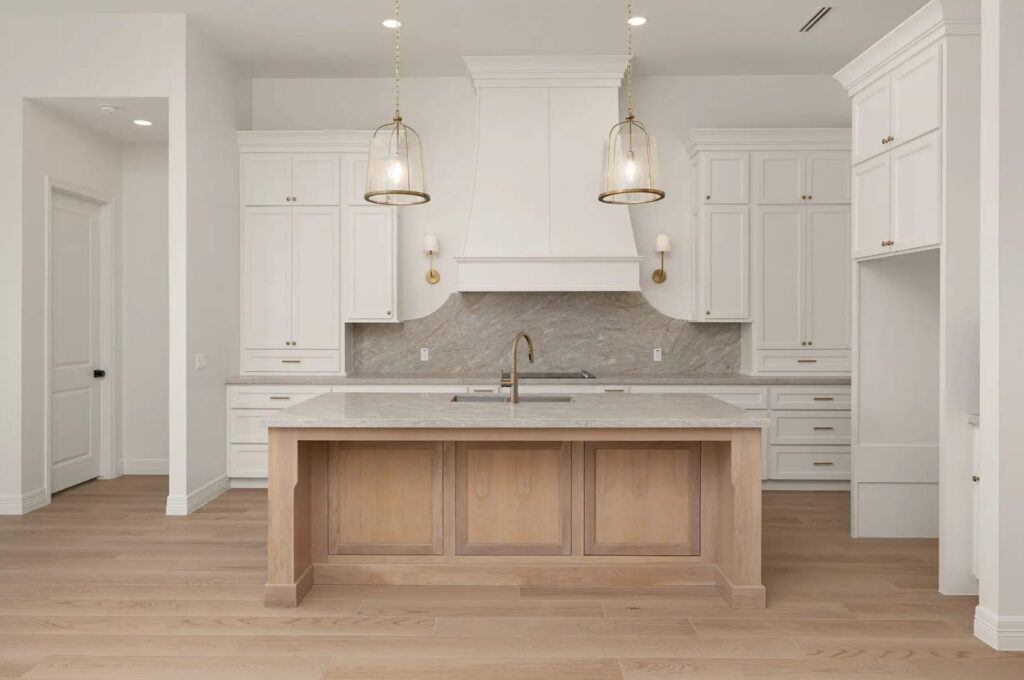
Most homeowners choose a door style — Shaker, slim Shaker, flat panel — and assume that is the decision. But there is a second choice underneath it that changes the look of a kitchen just as much, and almost nobody brings it up unprompted: overlay.
Overlay describes how much of the cabinet’s face frame the door covers. Same Shaker door, three different overlays, three noticeably different kitchens. Here is what each one is, what it costs in Charlotte, and how to choose.
First, What a Face Frame Is
Partial Overlay: The Builder Standard
Partial overlay doors cover part of the frame and leave roughly 1 to 2 inches of frame visible between and around doors. You see a clear grid of wood between every door and drawer.
This is what most production builders install, and it is the least expensive configuration because tolerances are forgiving — a door that is an eighth of an inch off simply is not noticeable against that much visible frame.
– Look: traditional, and to most eyes, standard
– Cost: lowest
– Best for: rentals, flips, budget-led kitchens, or matching existing partial-overlay cabinetry elsewhere in the house configuration that gets you there.
Full Overlay: The Modern Default
Full overlay doors cover nearly the entire face frame, leaving only a narrow reveal — typically an eighth to a quarter inch — between adjacent doors. The cabinet run reads as a continuous surface of doors and drawer fronts rather than a grid of framed openings.
This is the configuration most Charlotte homeowners actually want when they say they want their kitchen to look modern and expensive. It delivers the clean frameless aesthetic while keeping the structural advantages and easier installation of a framed cabinet.
– Look: clean, contemporary, transitional
– Cost: moderate premium over partial overlay
– Best for: the large majority of kitchens, new builds, and renovations aiming for a current look
Full overlay does require better manufacturing than partial. With a quarter-inch reveal, a door that hangs slightly out of square is visible. This is a place where a quality cabinetmaker separates from a cheap one.
Inset: The Furniture-Grade Option
– Look: refined, traditional, furniture-grade, unmistakably custom
– Cost: typically 15–30% above comparable full overlay
– Best for: historic and traditional homes, high-end transitional kitchens, butler’s pantries and built-ins where the detail is the point
You can also choose exposed butt hinges, which are visually part of the design and lean traditional, or concealed hinges, which keep the inset look but read more contemporary.
The Practical Trade-Offs
Storage. Inset loses a little interior clearance — roughly half an inch to an inch per opening — because the door occupies space inside the frame. Across a whole kitchen this is minor, but on narrow cabinets and on drawers sized for specific cookware it can matter. Full overlay on a framed box gives you the most usable opening of the three.
Maintenance and adjustment. Tight reveals show everything. An inset door that shifts a sixteenth of an inch with the seasons is visible; the same movement behind a full overlay door is not. Inset kitchens benefit from an adjustment visit after the first year.
Humidity. This matters in Charlotte. Wood moves with seasonal humidity swings, and inset construction has the least tolerance for that movement. It is entirely workable — inset kitchens perform well here every day — but species selection, a quality catalyzed finish, and a maker who accounts for seasonal movement all matter more than they would with overlay doors.
Installation. Inset takes longer to install and to fine-tune, which is part of the cost premium and worth knowing when you plan the schedule.
How the Three Compare on Cost
– Partial overlay: roughly 5–15% below full overla
– Full overlay: baselin
– Inset: roughly 15–30% above full overlay
– Beaded inset: at the top of that range or beyond
seeing quoted on your specific kitchen rather than estimated as a percentage.
Matching Overlay to Your Home
– 1920s–1950s Charlotte homes, Dilworth and Myers Park bungalows: inset is the historically correct choice and looks it
– Transitional new builds in Ballantyne, Waxhaw, and Fort Mill: full overlay, or flush inset on the island if you want one elevated moment
– Contemporary homes: full overlay, or frameless if you want to remove the frame entirely
– Rentals and flips: partial overlay, and spend the savings on hardware and finish
A common and effective compromise: full overlay on the perimeter, inset on the island or a single feature run. You get the refined detail where the eye lands and where guests stand, without paying the premium across every cabinet in the room.
The Short Version
– Want the cleanest current look at a sensible price? Full overlay. This is the right answer for most Charlotte kitchens.
– Have a traditional or historic home, or want the kitchen to read as genuinely bespoke? Inset.
– Budget is the deciding factor and the kitchen needs to be functional and clean? Partial overlay, with good hardware.
See the Difference in Person
Come look, or book a free design consultation and we will show you the same kitchen drawn and priced in full overlay and inset so you can see the real difference for your space and your budget. We serve Charlotte, Ballantyne, SouthPark, Myers Park, Matthews, Huntersville, Lake Norman, Concord, Waxhaw, Fort Mill, Rock Hill, and surrounding NC/SC communities.
Frequently Asked Questions
What is the difference between inset and overlay cabinets?
Overlay doors sit on top of the cabinet face frame and cover part or all of it. Inset doors sit flush inside the frame opening, so the door face is level with the frame. Inset is the more traditional and more expensive construction because it demands much tighter tolerances — every door must be fitted precisely to its own opening rather than simply mounted over it.
How much more do inset cabinets cost?
In Charlotte in 2026, inset typically adds 15–30% over comparable full overlay cabinetry. On a 20-linear-foot kitchen that is often a few thousand dollars. The premium pays for tighter manufacturing tolerances, more precise hinges, and significantly more labor at both build and installation, since each door is fitted to its specific opening.
What is full overlay vs partial overlay?
Partial overlay doors cover part of the face frame and leave roughly 1–2 inches of frame visible between doors — it is the standard, least expensive configuration and reads as builder-grade. Full overlay doors cover nearly the entire frame, leaving only a narrow reveal between doors, producing a cleaner and more contemporary look for a moderate price increase.
Do inset cabinets have less storage?
Slightly. Because the door sits inside the frame rather than over it, the clear opening is narrower by roughly half an inch to an inch per cabinet, and hinges take a little interior room. Across a full kitchen the practical difference is small, but it is most noticeable on narrow cabinets and on drawer widths, where an inch of lost clearance can matter for large trays or cookware.
Are inset cabinets a good idea in North Carolina humidity?
They work well, but they demand better material and finish choices. Inset reveals are tight and uniform, so any seasonal wood movement is visible in a way it is not with overlay doors. Choosing a stable species, a quality catalyzed finish, and a maker who understands seasonal adjustment matters more with inset than with any other configuration.
Which overlay is best for resale in Charlotte?
Full overlay is the safest choice for resale in most Charlotte homes — it reads as current and well-made without being polarizing. Inset adds genuine perceived value in higher-end neighborhoods and older homes where the detail matches the architecture. Partial overlay is unlikely to add value because buyers read it as the builder standard it usually is.
Ready to start your cabinet project?
Visit Our Showrooms
We’d love to welcome you to one of our showroom locations. Visit us to explore our cabinetry collections, discuss your project, and experience the craftsmanship that defines FigTree Cabinets.