
Quick Answer
A custom Charlotte mudroom or drop zone runs $4,500–$15,000 installed in 2026 depending on size and features. The most important sizing decision is locker width — plan 14–18 inches per person. Bench height should be 16–18 inches; coat hook height 60–66 inches for adults and 42–48 inches for kids. Tile or LVP flooring under the mudroom outperforms hardwood in Charlotte humidity and rain.
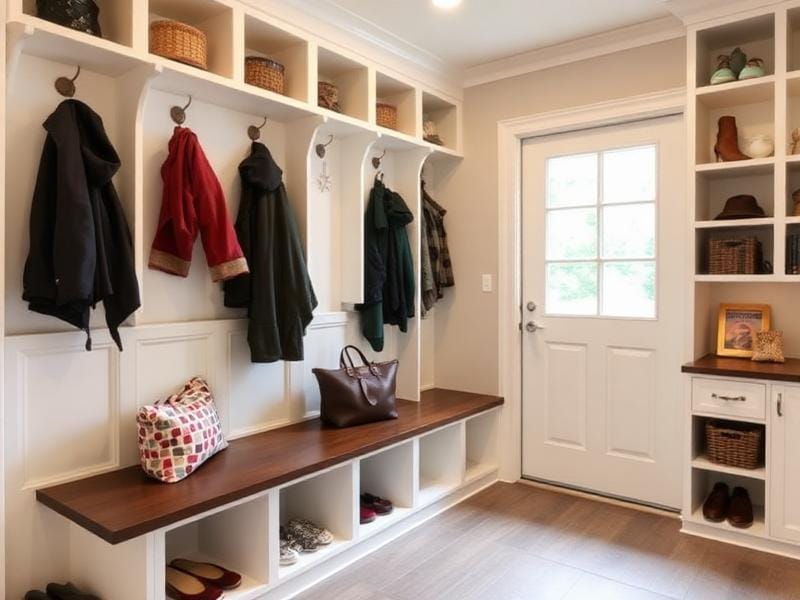
The mudroom is the highest-friction cabinetry zone in any Charlotte family home. It’s used dozens of times per day, in wet shoes, by people in a hurry, often with kids, often with pets, and almost always near the garage where dirt, mulch, and rainwater come in with every entry. It’s also the space where good cabinetry design returns the most daily quality of life — more than the kitchen, more than the closet, more than anywhere else in the house.
This guide walks through what we’ve learned designing Charlotte mudrooms and drop zones across new-builds in Waxhaw and Ballantyne, garage-entry renovations in SouthPark, and tight back-entry conversions in Plaza-Midwood, Dilworth, and Cotswold. Real sizing, real 2026 costs, and the design moves that separate a mudroom you use from one that ends up cluttered within a month.
This guide walks through what we’ve learned designing Charlotte mudrooms and drop zones across new-builds in Waxhaw and Ballantyne, garage-entry renovations in SouthPark, and tight back-entry conversions in Plaza-Midwood, Dilworth, and Cotswold. Real sizing, real 2026 costs, and the design moves that separate a mudroom you use from one that ends up cluttered within a month.
Mudroom vs Drop Zone: Pick the Right Scope First
Mudroom. A dedicated room — usually 30–60 square feet — with a door separating it from the rest of the house. Standard in Ballantyne, Waxhaw, Weddington, Lake Norman, and Fort Mill new-builds. Big enough for full-height lockers, a bench, upper storage, a tile floor, and often a sink or dog wash.
Drop zone. A 4–7 foot wide cabinet installation against a wall, typically in a hallway between the garage and kitchen. Best fit for older Charlotte homes (Myers Park, Dilworth, Plaza-Midwood, NoDa, Elizabeth) that don’t have a dedicated mudroom but have a clear garage-to-kitchen path. Smaller scope, faster install, lower cost.
The choice is almost entirely architectural. If you have the room, build a mudroom. If you don’t, a well-executed drop zone serves 80% of the function in 30% of the space.
Sizing for a Real Family
Locker width. Plan 14–18 inches per daily user. A 14″ locker fits a kid’s coat and backpack. An 18″ locker comfortably fits an adult coat plus a backpack hung on a side hook plus a shelf above for hats. For a family of four, plan a minimum 60″ run of lockers; 72″ is more comfortable and lets you add a guest or pet locker without crowding.
Locker depth. 14–18 inches. Deeper than 18″ wastes floor space; shallower than 14″ pushes coats into the walking path.
Bench height. 16–18 inches tall. Lower feels like a step, higher is uncomfortable for kids putting on shoes.
Hook heights. Adult coat hooks: 60–66 inches above the floor. Kid coat hooks: 42–48 inches. If you have both, run two rows. Backpack hooks should be lower than coat hooks since backpacks are heavier and dropped from a sitting position.
Upper cabinet height. Tops of upper cabinets to ceiling — close it off. Open soffit space above mudroom lockers becomes a dust catcher and visually breaks the architectural rhythm of an otherwise clean elevation.
Closed Cabinets vs Open Lockers
The biggest design debate. Both approaches work, but only one approach for the whole mudroom never works.
Open lockers / hooks / cubbies. Fast to use. Visible reminder of who left their stuff behind. Forces the family to keep things put away because the mess is on display.
Closed cabinets / drawers. Hides clutter. Slows daily use because every interaction requires opening a door. Tends to get ignored — the open kitchen counter becomes the real drop zone instead.
The hybrid that actually works: open hooks and a backpack/coat zone in the upper section (where speed matters), closed cabinets or drawers in the lower section for shoes, seasonal items, and overflow. Bench top stays clear because the bench is for sitting, not storing.
The Features That Earn Their Cost
After hundreds of Charlotte mudrooms, these are the features homeowners thank us for after six months of use:
Charging drawer. A pull-out drawer with internal outlets sized for phones, tablets, and AirPods. Kills the kitchen counter charging clutter. Adds roughly $400–$700 to the build.
Hidden mail sorter. A narrow vertical section (3–4 inches wide) with file slots inside an upper cabinet door. Mail goes in on the way through, not piled on the kitchen island. Roughly $300–$500 added.
Dog wash. Tiled enclosure with handheld sprayer at lower-back-friendly height (24–28 inches), typically at one end of the mudroom. For Charlotte households with medium or large dogs (which is most of them), this is the single most-used feature in the mudroom. $3,500–$7,500 fully installed including tile, plumbing, and cabinetry adjustments.
Pull-out shoe storage with vented bases. Drawers sized for shoe storage with louvered or perforated bases so wet shoes can air-dry. Far better than open cubbies that hold visible wet shoes in the entryway.
Sports/gear hooks at low height. Soccer cleats, gym bags, baseball gloves. Charlotte family-suburb mudrooms (Waxhaw, Weddington, Fort Mill, Huntersville) almost always need a dedicated 18″ wide hook zone for seasonal sports gear.
The Features That Are Overrated
Single-piece bench tops in stone. Looks great in photos; chips when a metal water bottle gets dropped on it. Painted wood or LVT bench tops perform better in real family use.
Built-in calendars or chalkboards. Used for the first month, ignored thereafter. The kitchen calendar and phone calendars have already won. Skip the chalkboard wall and put that elevation toward another locker.
Closed laundry hampers in lockers. Sounds organized; in practice clothes get tossed on top instead of opened into. A small open hamper bin is used more often.
Flooring and Wall Materials
Floor. Porcelain tile or luxury vinyl plank (LVP). Both handle wet boots, dog accidents, salt residue, and Charlotte humidity without failing. Hardwood mudrooms warp within 3–5 years in NC. If your existing floor is hardwood and a mudroom retrofit is planned, the right move is to tile the mudroom footprint specifically and transition cleanly at the doorway.
Walls. Eggshell or satin painted drywall is fine for most mudrooms. Consider tongue-and-groove or beadboard wainscot up to bench height in mudrooms that take heavy daily abuse from kids and pets — it hides scuffs and is easier to wipe down than flat paint.
Walls. Eggshell or satin painted drywall is fine for most mudrooms. Consider tongue-and-groove or beadboard wainscot up to bench height in mudrooms that take heavy daily abuse from kids and pets — it hides scuffs and is easier to wipe down than flat paint.
2026 Charlotte Mudroom Pricing
Real ranges from our 2026 installs:
– Drop zone (4–6′ wide, bench + hooks + closed lower cabinet): $4,500–$7,500 installed
– Basic mudroom (6–8′ wide, lockers + bench + closed lower): $6,500–$11,000 installed
– Full-feature family mudroom (60–84″ of locker, bench, upper closed cabinets, charging drawer, mail sorter): $9,000–$15,000 installed
– Premium mudroom with quartz bench top, custom tile niches, integrated lighting, paneled appliance-style hooks: $18,000–$28,000+ installed
Stone bench tops add $700–$1,500. Adding a sink (utility sink for boots or plants) adds $1,500–$3,000 with plumbing rough-in.
Common Charlotte Mudroom Mistakes
1. Hooks too high. Adult-height hooks installed in a family mudroom means kids can’t hang their own coats — and you do it for them, forever.
2. No closed shoe storage. Open shoe cubbies look great empty; with two pairs per family member, they always look cluttered.
3. Bench too narrow. 12″ deep benches push knees into the wall when sitting. 14–16″ is the comfortable minimum.
4. Hardwood floor. Will fail within 5 years in Charlotte humidity with daily wet shoes.
5. Skipping the dog wash in a dog-heavy household. Charlotte family mudrooms without dog washes are the #1 ‘wish I had added’ renovation regret we hear at follow-up consultations.
Ready to Plan Your Charlotte Mudroom or Drop Zone?
We design and install custom mudrooms and drop zones across Charlotte, Ballantyne, SouthPark, Myers Park, Lake Norman, Huntersville, Cornelius, Davidson, Matthews, Waxhaw, Weddington, Concord, Fort Mill, and Rock Hill. Free in-home consultations include a measurement, family-flow assessment (how the space actually gets used), and 3D renderings of the proposed mudroom in your home before you commit to anything.
Frequently Asked Questions
How much does a custom mudroom cost in Charlotte NC?
In 2026, a basic Charlotte mudroom (bench, hooks, upper cabinets, 6–8 feet wide) runs $4,500–$8,000 installed. A full-feature mudroom with individual lockers for a family of four, drawers, charging station, and quartz bench top runs $8,000–$15,000. Adding a dog wash, custom tile niche, or built-in storage tower can push the project to $18,000–$25,000.
What is the difference between a mudroom and a drop zone?
A mudroom is a dedicated room with a door, often near the garage or back entry, designed for taking off wet/dirty outerwear. A drop zone is a smaller cabinetry installation (often 4–6 feet wide) inside another room — typically near a kitchen-to-garage entry — designed to catch keys, mail, bags, and shoes without requiring a separate room.
How wide should mudroom lockers be?
Plan 14–18 inches of locker width per person. 14″ works for kids and minimalists; 18″ gives adults room for a full coat plus a backpack hung beside it. Charlotte family-of-four mudrooms typically run 60–72 inches of locker space plus a separate cabinet or hook area for guests, sports gear, or pets.
What is the right bench height for a mudroom?
16–18 inches tall is the right range for adults and works for children old enough to dress themselves. Below 15″ feels like sitting on a step; above 19″ is uncomfortable for shorter family members. Bench depth should be 14–16 inches — deeper benches collect dropped items, shallower benches push knees into hooks above.
Should mudroom storage be open or closed?
Most successful Charlotte mudrooms are hybrid: open hooks and cubbies in the upper section (fast to use, visible reminder of who left what behind), closed cabinets or drawers in the lower section for shoes and seasonal items. All-open feels cluttered within weeks; all-closed gets ignored because the friction is too high.
Should I add a dog wash to my mudroom?
If you have a medium or large dog and a garage-entry mudroom, yes — it’s one of the highest-satisfaction additions we install in Charlotte. Plan for $1,500–$3,500 in cabinetry adjustments plus $2,000–$4,000 for the tiled enclosure, plumbing, and a handheld sprayer. Skip it for small dogs or if your mudroom is tight on space.
What flooring is best for a Charlotte mudroom?
Porcelain tile or luxury vinyl plank (LVP). Both handle wet boots, salt residue, pet accidents, and NC humidity without warping. Hardwood flooring in mudrooms consistently fails within 3–5 years in Charlotte from cyclic wetting. If your existing floor is hardwood, plan to tile the mudroom zone specifically.
How long does a Charlotte mudroom project take?
6–10 weeks from signed proposal to final install. Design and selection: 1–2 weeks. Production: 4–7 weeks. Cabinet install: 2–3 days. If you’re adding tile, plumbing for a dog wash, or new flooring, add another 1–2 weeks for the trade coordination after cabinetry is in.
Ready to start your cabinet project?
Visit Our Showrooms
We’d love to welcome you to one of our showroom locations. Visit us to explore our cabinetry collections, discuss your project, and experience the craftsmanship that defines FigTree Cabinets.